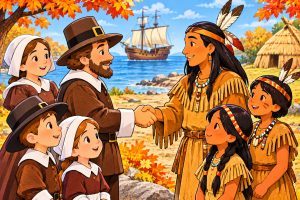
The Story of the First Thanksgiving takes children back to the early 1600s, when English settlers arrived in North America and began building a new community. Their first year was filled with challenges, but they also learned about the land and its resources from the Wampanoag people, who had lived there for generations.
Through narration, movement, and simple group lines, children will bring this story to life while learning about cooperation, kindness, and gratitude.
CHARACTERS:
(The number of participants is flexible. Children can play more than one role if necessary.)
- NARRATOR 1
- NARRATOR 2
- PILGRIM CHILDREN AND ADULTS
- WAMPANOAG CHILDREN AND ADULTS
- SQUANTO (TISQUANTUM)
- GROUP OF CHILDREN FOR THE FINAL CHORUS
MATERIALS NEEDED:
- A cardboard ship or boat
- Blue fabric or paper to represent the ocean
- A table
- Baskets
- Artificial corn, fruit, vegetables, and bread
- Simple harvest decorations
- Autumn-colored leaves
- Optional background music
PERFORMANCE NOTES:
- This performance is suitable for large or small groups.
- Narrators can read the story while children act out each scene.
- Background music can be used during the journey, springtime, and harvest scenes.
- Costumes and props can be simple and made with classroom materials.
- The teacher can add more children to the group scenes.
- The performance can be adapted for younger students by having the narrators read all the text.
SCRIPT:
SCENE 1: THE JOURNEY
(Soft ocean music begins. Children pretend to be aboard a ship. They gently sway from side to side.)
NARRATOR 1: Many years ago, a group of English settlers decided to leave their homeland and travel across the ocean. They were searching for a place where they could practice their religion freely.
NARRATOR 2: In September 1620, they sailed aboard a ship called the Mayflower. Their journey across the Atlantic Ocean was long and difficult.
(The children pretend to look at the waves and hold on to the ship.)
PILGRIM CHILD 1: The ocean is so big!
PILGRIM CHILD 2: I hope we reach land soon!
PILGRIM GROUP: We must be brave and help one another!
(The ship slowly moves toward the other side of the stage.)
NARRATOR 1: After many weeks at sea, the settlers finally reached the shores of North America.
SCENE 2: A NEW LAND
(The Pilgrims step off the ship and look around. Some carry baskets or small bags.)
NARRATOR 2: They settled in an area that was part of the Wampanoag homeland. Everything was new to them, and they had much to learn.
(The children look around and pretend to gather berries and seeds.)
PILGRIM CHILD 1: Look! I found some berries!
PILGRIM CHILD 2: And I found some seeds!
NARRATOR 1: Their first winter was extremely difficult. The weather was cold, food was scarce, and many settlers became ill.
(The Pilgrims pretend to shiver and help one another.)
PILGRIM GROUP: We must stay together and help each other!
NARRATOR 2: When spring arrived, they began preparing for a new season.
(The children stretch their arms toward the sun and smile.)
PILGRIM CHILDREN: Spring is here! What a beautiful day!
SCENE 3: THE WAMPANOAG PEOPLE
(Wampanoag children and adults enter the stage. They carry baskets or pretend to plant seeds.)
NARRATOR 1: The Wampanoag people had lived in this region for thousands of years. They knew the land, the seasons, and the many ways to grow and gather food.
NARRATOR 2: They shared their knowledge with the English settlers. They showed them how to plant corn and explained how to find food in the surrounding land and waters.
(A Wampanoag person demonstrates how to plant seeds. The Pilgrims watch carefully.)
WAMPANOAG PERSON 1: Place the seeds carefully in the soil.
PILGRIM CHILD 1: Like this?
WAMPANOAG PERSON 1: Yes! Now give them water and let them grow.
WAMPANOAG PERSON 2: We can also teach you about fishing and gathering food.
PILGRIM GROUP: Thank you for sharing your knowledge!
NARRATOR 1: One of the Wampanoag people who helped the settlers communicate and learn about planting crops was Tisquantum, also known as Squanto.
(Squanto enters and greets the group.)
SQUANTO: We can learn from one another when we listen and work together.
NARRATOR 2: The communities began a period of cooperation, although their relationship was also shaped by important political agreements and different interests.
SCENE 4: THE HARVEST
(The stage changes. Children enter carrying baskets of corn, fruit, and vegetables.)
NARRATOR 1: As the seasons passed, the settlers worked hard to grow food. At last, they gathered a successful harvest.
NARRATOR 2: In the autumn of 1621, the English settlers held a harvest celebration. Wampanoag people also joined the gathering, which lasted for several days.
(The children arrange food on the table.)
PILGRIM CHILD 1: Look at all the food!
PILGRIM CHILD 2: We have worked so hard!
WAMPANOAG CHILD 1: A good harvest is something to celebrate.
WAMPANOAG CHILD 2: We must always remember to care for the land.
NARRATOR 1: People gathered, shared food, and spent time together.
(The children sit or stand around the table.)
PILGRIM GROUP: We are thankful for our harvest!
WAMPANOAG GROUP: We are thankful for our community and our traditions!
NARRATOR 2: Harvest celebrations and traditions of giving thanks were already part of both English and Wampanoag cultures.
SCENE 5: A TIME TO GIVE THANKS
(Gentle music begins. The children step forward one at a time.)
NARRATOR 1: Today, Thanksgiving is celebrated in many homes and communities. It is a time to remember the importance of gratitude, generosity, and sharing.
NARRATOR 2: We can all be thankful for the people who care for us, the food we eat, the friends we make, and the kindness we receive.
CHILD 1: I am thankful for my family!
CHILD 2: I am thankful for my friends!
CHILD 3: I am thankful for the food we share!
CHILD 4: I am thankful for the beauty of nature!
CHILD 5: I am thankful for everyone who helps me!
ALL CHILDREN: Let us always be grateful and kind!
NARRATOR 1: And that is the story of a harvest celebration that became part of the history of Thanksgiving.
NARRATOR 2: May we remember that gratitude is something we can practice every day!
ALL: Happy Thanksgiving!
THE END
AUTHOR: K I D S I N C O
Conclusion: Thanksgiving is a reminder that gratitude should be part of our everyday lives. We can show it by helping others, sharing what we have, respecting different traditions, and appreciating the people who make our lives special.
Moral of the Story: A grateful heart recognizes the kindness of others. We should appreciate what we have, respect different cultures, and remember that helping one another makes our communities stronger.
Moral Values:
- Gratitude
- Generosity
- Cooperation
- Kindness
- Respect
- Friendship
- Sharing
- Appreciation of nature
👉 More Kidsinco’s Thanksgiving play scripts to Enjoy:
👉 Explore our full collection of free play scripts for kids, perfect for classroom performances.
👉 Resources:
- National Museum of the American Indian – Rethinking Thanksgiving Celebrations
- Plimoth Patuxet Museums – Thanksgiving
- First Thanksgiving – National Geographic Kids
- National Archives – Thanksgiving: Historical Perspectives
This play script, “The Story of the First Thanksgiving,” is the property of Kidsinco and may not be republished, copied, or distributed on any other website, blog, forum, or social media platform without written permission from Kidsinco. It is intended for personal and educational use only.
BookPlay Tickets
Thank you for visiting Kidsinco Free Play Scripts for Kids!